The short answer
Many homes in Delhi NCR receive hard water, and it can leave white scale and a dull film on marble, especially around taps, shower areas and wet floors. The fix is mostly habit: wipe water dry, use a pH-neutral cleaner, and never reach for an acidic descaler.
Water hardness varies by locality, by whether you draw on a municipal line or a borewell, and by whether a softener sits in between. So treat everything below as general guidance, and check your own water if marks keep returning.
| Problem | What you see | Safe first step | Avoid |
|---|---|---|---|
| Limescale film | White chalky crust near taps | Warm water, neutral cleaner, soft cloth | Acidic descalers |
| Etch mark | Dull spot, polish lost | Ask a specialist about re-polishing | Scrubbing harder |
| Water spots | Round rings on dark stone | Wipe dry, buff with a soft cloth | Leaving puddles |
| Soap residue | Cloudy film in shower area | Squeegee daily, neutral cleaner | Harsh bathroom acids |
What hard water actually does to stone
Hard water carries dissolved minerals, mostly calcium and magnesium. When a film of it dries on a surface, the water evaporates and the minerals stay behind as a pale, chalky crust. On a polished stone this reads as a cloudy haze or white spots, and on a dark stone it shows up even more.
This is limescale sitting on top of the stone. It is a different problem from etching, where acid chemically eats the polish. Telling the two apart matters, because the cure for one can cause the other. Our guide on stain versus etch on marble shows how to read a mark.
Why marble is more sensitive than granite
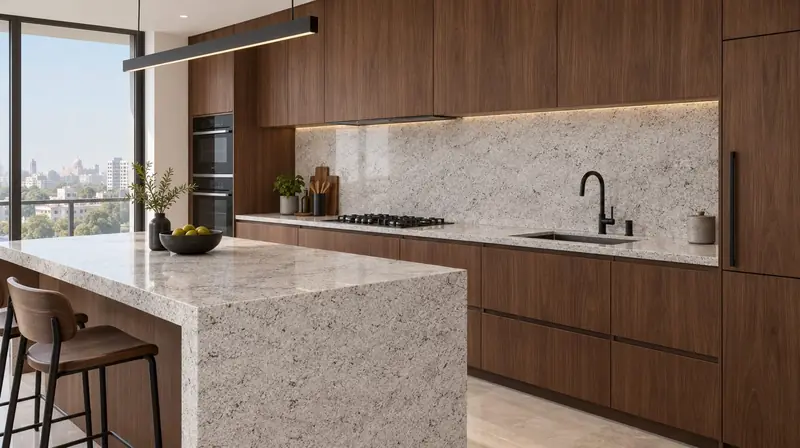
Marble is mostly calcium carbonate, so it reacts with acids. Granite is made of harder, mostly silicate minerals that shrug off the same chemicals. That is why a granite kitchen counter forgives a lot, while a white marble bathroom floor needs more thought.
The usual trap in Delhi NCR homes is the household descaler or a strong toilet-cleaning acid. These dissolve scale quickly, but on marble they also dissolve a little of the surface, leaving a dull patch that no amount of scrubbing restores. If you want to compare the two stones for wet areas, granite is the lower-maintenance family.
Where scale shows up first
Look at the places where water dries in the same spot every day.
The base of a bathroom wall behind the tap, the strip beside a shower tray, the floor around a washbasin, the kitchen counter beside the sink, and balcony or terrace stone where tank overflow or washing water pools. Floors washed with a bucket and left to air dry in a hot, dry spell also collect a fine film that builds over weeks.
A routine that works in a hard-water home
Keep it simple and regular rather than occasional and aggressive.
Wipe wet surfaces dry after use, using a soft cloth or a squeegee in the shower. Mop floors with clean water and a pH-neutral stone cleaner, then go over them once with a dry mop so no film is left. Keep a bowl of fresh drinking water out of the way of the stone, and use coasters and trays under bottles and soap dispensers.
A good sealer slows absorption of water and stains but does not stop scale from forming on the surface. Read how often to seal marble and granite before you plan it, and ask your fabricator which product suits the stone.
Treating scale already on the stone
Start with the gentlest option. Soak a soft cloth in warm water with a few drops of neutral cleaner, lay it over the mark for a while, then wipe and dry. A soft nylon pad can lift a light film without scratching a polished face.
For stubborn build-up, ask a stone-care specialist or your contractor before using any product. Avoid vinegar, lemon, citric descalers and bathroom acids on marble. If the surface has already gone dull, the honest answer is that it needs re-polishing by a professional, not another round of cleaning.
Planning ahead when you choose stone
If you are still choosing, think about where the water will be. A honed or leathered finish hides marks better than a mirror polish, and a busy veining pattern hides haze better than a plain white. In wet areas, a stone with natural movement such as Carrara White from Carrara, Italy is more forgiving than a flawless plain slab, though it is still marble and still needs care.
If a softener or filter is practical in your building, it reduces scale at the source and also helps taps and fittings. You can see more options under Italian marble, and view full slabs at our experience centre.
Bring your questions to the slab
The experience centre at C-19 Sharda Puri, Main Ring Road, near Rajouri Garden, New Delhi 110015 displays full slabs, and you can reserve slabs in your own name. Bring a photo of your bathroom or kitchen and describe how the water behaves there. Buyers from across Delhi NCR are welcome to visit the experience centre or contact the team to talk it through before deciding.