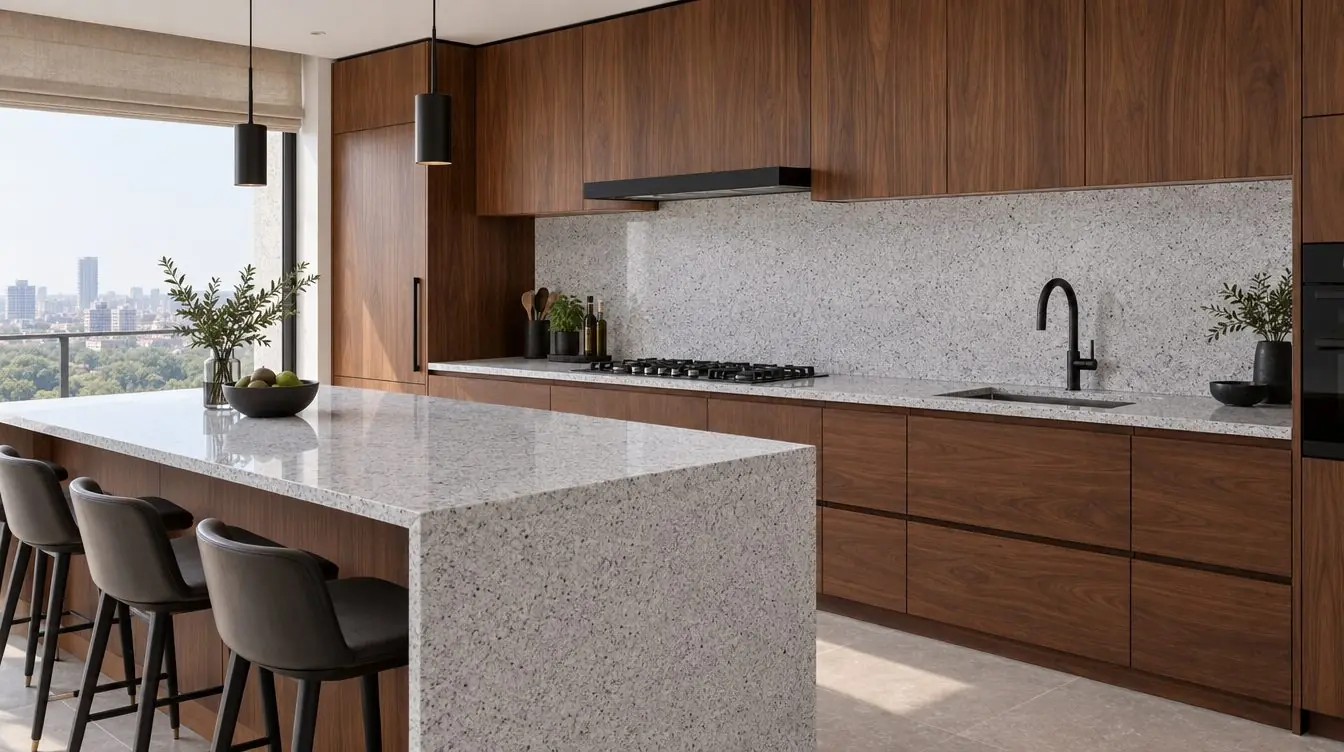
Which one should you choose?
Choose granite where the surface works hard, such as a kitchen counter, a staircase, an entrance or a parking area, and choose marble where you want softness and light, such as living rooms, bedrooms, bathrooms and feature walls. Many Indian homes use both: marble through the living areas and granite in the kitchen and outdoors.
The reasons come down to how each stone is formed, and that explains almost everything about how it behaves once it is installed.
| Marble | Granite | |
|---|---|---|
| Formed as | Metamorphic rock, mostly calcite | Igneous rock of quartz, feldspar and mica |
| Scratch resistance | Softer, can scratch | Much harder |
| Acids such as lemon and vinegar | Etch a polished surface | Generally resists |
| Hot pans | Use a trivet | Handles heat well |
| Look | Soft, flowing veins | Speckled, crystalline pattern |
| Best suited to | Living rooms, bedrooms, bathrooms, feature walls | Kitchen platforms, stairs, entrances, outdoor areas |
| Upkeep | Seal, wipe spills fast, use pH-neutral cleaners | Seal as advised, routine cleaning |
Two different stones
Marble is a metamorphic rock: limestone that has been reheated and recrystallised deep underground, which is why it is made mostly of calcite and carries long, flowing veins. Granite is an igneous rock that cooled slowly from molten magma. It is made of interlocking crystals of quartz, feldspar and mica, which gives it a speckled, granular look.
Marble tends to look soft and continuous. Granite looks crystalline, with a pattern that is usually more even across the slab.
Hardness and wear
Granite is considerably harder than marble. On the Mohs scale marble sits at roughly 3 to 4 and granite at roughly 6 to 7, though individual stones vary. In practice granite shrugs off the knocks, grit and heavy traffic of a kitchen or an entrance far better. Marble can scratch and will lose its polish faster where shoes and furniture move every day, although a scratched marble floor can always be honed and re-polished by a stone contractor.
Acids, stains and sealing
Because marble is calcite, acids react with it. Lemon juice, vinegar, tomato, some cleaners and even certain soft drinks leave dull marks called etches. Granite is largely unaffected by household acids. Both stones are porous to a degree, so both benefit from sealing, but granite is far more forgiving in a working kitchen.
If you love marble in the kitchen anyway, a honed finish and a sealer make the marks far less visible. Our note on stains and etches on marble explains what to expect.
Where each one belongs
For a kitchen, see our granite for kitchen page. For living spaces, browse the marble collection and the granite collection side by side to see the difference in character. A dark granite such as Steel Grey from Ongole, Andhra Pradesh is a practical counter, while a stone like Statuario from Carrara, Italy is chosen for the look of a room rather than for rough use.
Weight, edges and practicalities
Both stones are heavy, and slab size affects how they are carried up to a flat or a first floor, so mention access when you plan. Granite takes a crisp, polished edge that stays sharp for a long time, whereas marble edges can chip at corners if knocked. Granite counters are commonly 18 to 30 mm thick, while marble slabs for floors are commonly 16 to 20 mm, though this varies by supplier and use.
Seams also differ. Granite patterns are fairly uniform, so joints are easy to hide. Marble veining flows across the slab, so joints need planning if the pattern is to look natural.
What affects cost
Indian granite is usually more economical than imported marble, and Indian marble generally sits between the two. Even so, the category matters less than the specific stone, slab size, thickness, finish and the amount of cutting and matching involved. Compare like with like, and send us your drawings through the contact page to discuss a quotation for your actual stone.