What should you decide first for a stone island?
Decide the size of the island around the slab you intend to use. Islands are often the largest single piece of stone in a kitchen, and planning one without joints gives the best result, so check the usable slab size before finalising the design.
Everything else, from overhang to edge profile, follows from that choice.
It also helps to settle how the island will be used. A prep island needs a different height and edge from a breakfast bar, and the stone should serve both the way the family actually cooks and eats.
Slab size and joints
Many slabs are narrower or shorter than a large island needs. If a joint is unavoidable, it is best placed where it is least visible and where the veining can be matched. Your fabricator can mark out the layout on the actual slab before cutting begins.
Check the size after edges are trimmed, because the usable length is less than the quoted one.
Sinks and hobs cut into an island weaken the stone, so cutout positions need to leave enough material at the corners. Your fabricator will advise on the safe distance for your stone and thickness.
Overhangs and seating
A seating overhang on an island needs proper support. Small overhangs may be self-supporting, but larger ones need brackets or a supporting structure. As a rough rule, an overhang much beyond a quarter of a metre deserves support, though it depends on the stone and thickness. Ask your fabricator what is safe.
Granite counters are commonly 18 to 30 mm thick, and the thinner ones usually need more support than the thicker ones.
Legs or panels beneath an overhang can be designed into the cabinetry so that the stone looks light but is firmly held. Knee space for stools is usually considered at the same time.
Waterfall ends and edges
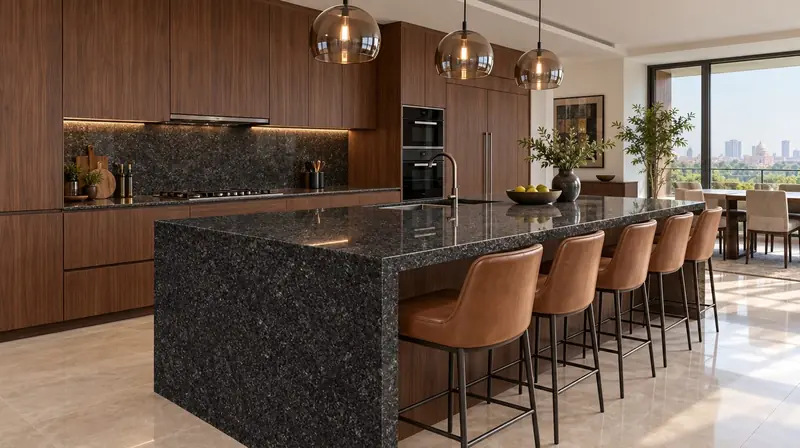
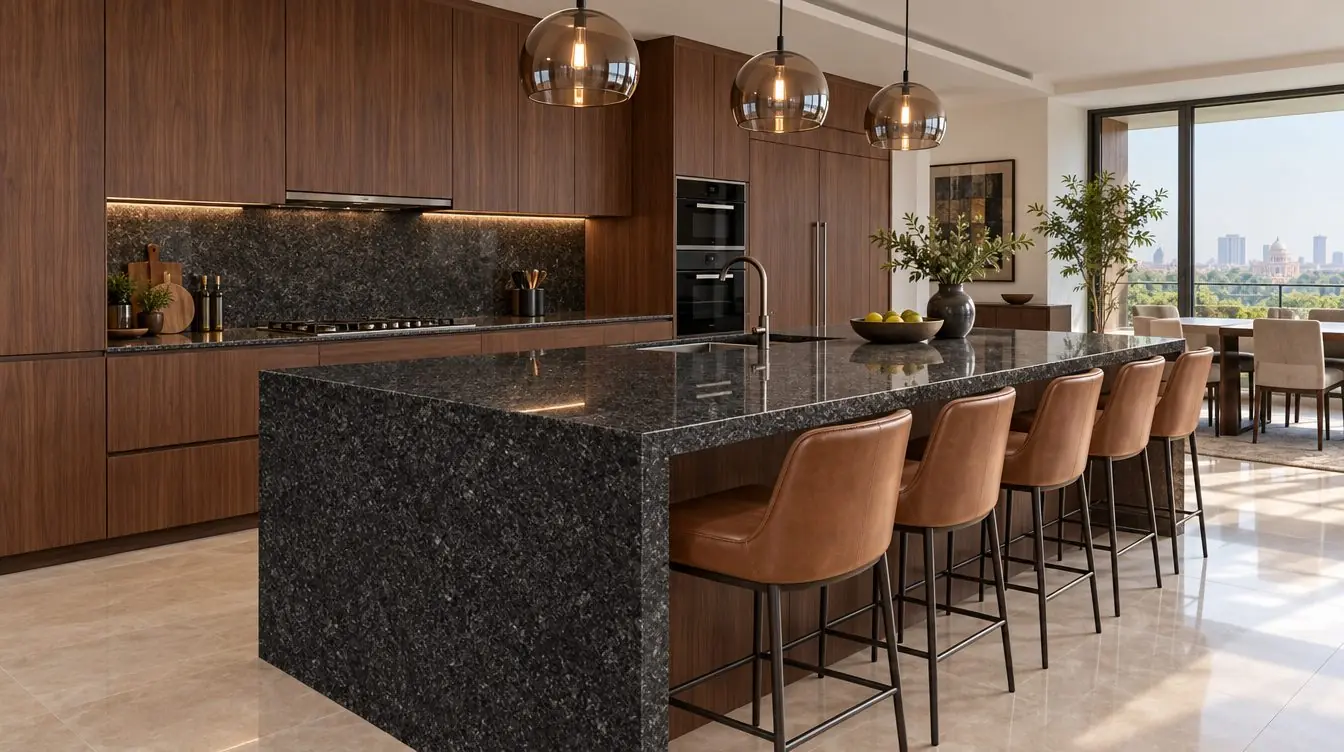
Taking the stone down the sides of an island, known as a waterfall, makes it look like a solid block. It works beautifully with veined stones, especially when the pattern is matched around the corner.
Eased, bevelled and bullnose edges are practical for busy islands. Mitred edges create the look of a thick slab using thinner stone.
Edge profiles also change the look. A plain eased edge feels modern, while an ogee or a bullnose is more traditional. Bring a sample of your chosen edge to compare. Whichever profile you pick, ask for the corners to be slightly rounded, since sharp stone corners chip more easily in a busy kitchen.
Choosing the stone
Islands are a chance to use something special: a dramatic quartzite such as Roma Blue, or a durable granite like Tan Brown. A granite island also copes well with children, hot pans and cooking oil.
For ideas on which granites perform best, see the kitchen countertop guide and the granite for kitchen page.
Next steps
Explore the granite collection and view full slabs at the experience centre. Price depends on the stone, slab size, thickness, edge work and any waterfall ends, so ask for a quotation once you have a drawing.
The more precise your measurements, the easier it is to say how many slabs you need.
If you are choosing between two stones, a sample cut in your intended edge on both is a worthwhile request. Seeing the edge in the actual stone often settles the decision faster than any drawing.