Why backlight stone
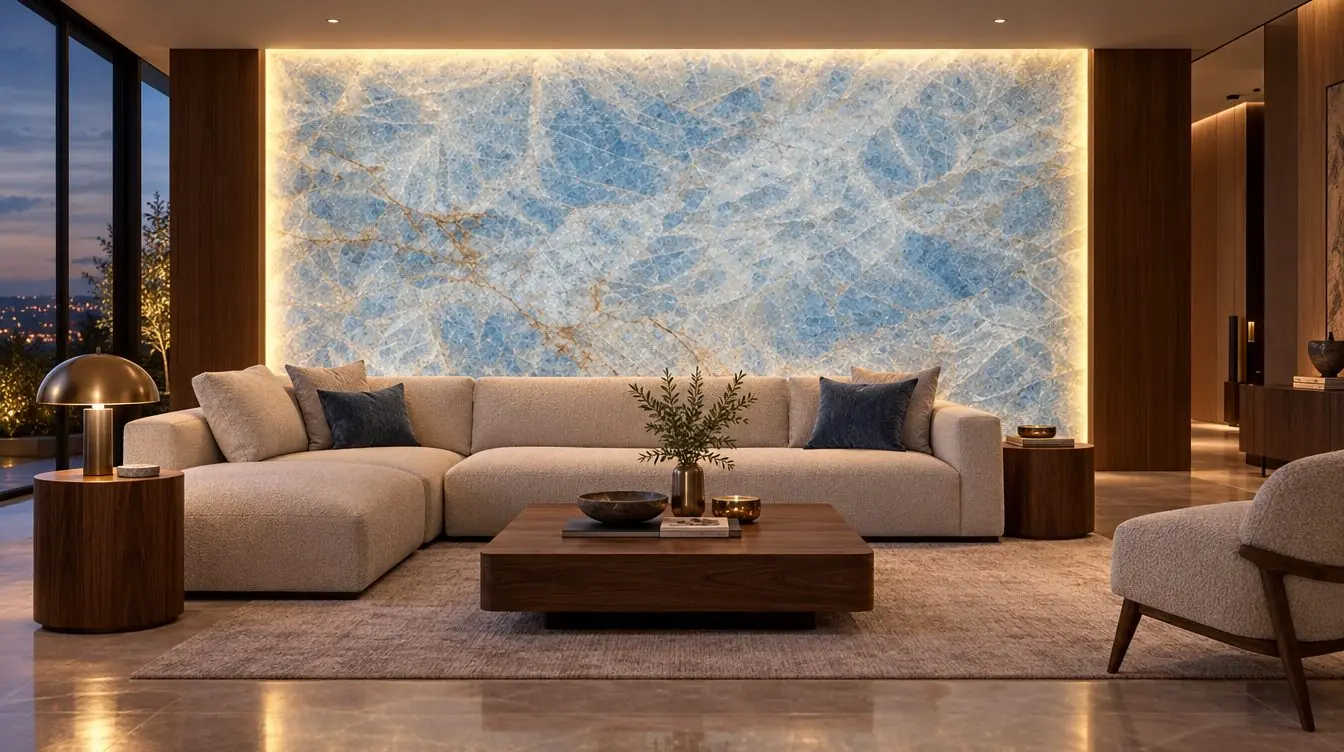
Onyx is the stone most often chosen for a backlit wall, because it is translucent enough to glow when light is placed behind it. Some stones are translucent enough to let light through when cut thin, and lit from behind, their banding and veins glow, creating a dramatic focal point for a bar, a reception, a bathroom or a living room.
The effect is closer to a lamp than to a surface, so plan it as a source of light as well as a wall. Think about how bright it should be, what is beside it and whether it will be on during the day.
Which stones work
Onyx is the classic choice: Blue Onyx, Champagne Onyx, White Crystal Onyx and Tiger Onyx all glow differently. Blue Onyx, Champagne Onyx and Tiger Onyx are imported from Isfahan in Iran. Some white marbles and quartzites also transmit light.
Honey and amber onyx tones glow warmly, while pale ones give a soft, even light. Dark bands can look dramatic in the lit stone. See more on the onyx marble page.
Dense, strongly banded onyx glows unevenly, with bright and dark zones, while pale, evenly figured slabs give the smoothest light. Neither is better; it depends on whether you want drama or calm.
Lighting
Even, diffused light is essential to avoid hot spots. LED panels or strips set at a suitable distance behind the stone, with a diffuser, give the most even glow. Warm white light flatters most onyx.
The colour temperature of the LEDs changes the stone's colour, so choose it with the stone, not after. A dimmer lets you move from a bright feature to a soft night glow. Test the lights with a sample before the wall is built.
Structure and safety
Thin translucent stone is often laminated to a clear backing for strength. The frame must allow access to the lights for maintenance and allow heat to escape.
Onyx is softer and more fragile than granite, so it suits walls, bar fronts and decorative panels better than floors or busy counters. Leave this construction to an experienced contractor, and make sure that electrical work is done by a qualified electrician. A bathroom wall needs moisture protection around the lights.
Allow for future access. LED strips eventually need replacing, and a wall that cannot be opened turns a small repair into a big one.
Choosing the slab
Backlighting exaggerates everything, including dark patches and cracks. Always view the slab with light behind it before committing. Our experience centre is the place to compare them, and slabs can be reserved in your name.
A phone torch held behind the edge of a sample shows a good deal about how the stone will glow. For ideas on how onyx works in other rooms, read onyx, the stone you can light from behind, and the notes on designing a marble bathroom. When you are ready, contact us.
Planning the budget and timeline
A backlit wall has several parts: the stone, the backing, the frame, the lighting and the electrical work. Each has its own supplier, so the total depends on size, stone grade and the complexity of the build. Decide the stone early, since onyx takes longer to select than ordinary marble.
Ask for slabs to be viewed together and book-matched, so veining runs across the wall in a pattern. Our note on book-matched marble explains how this works.