What book-matching means
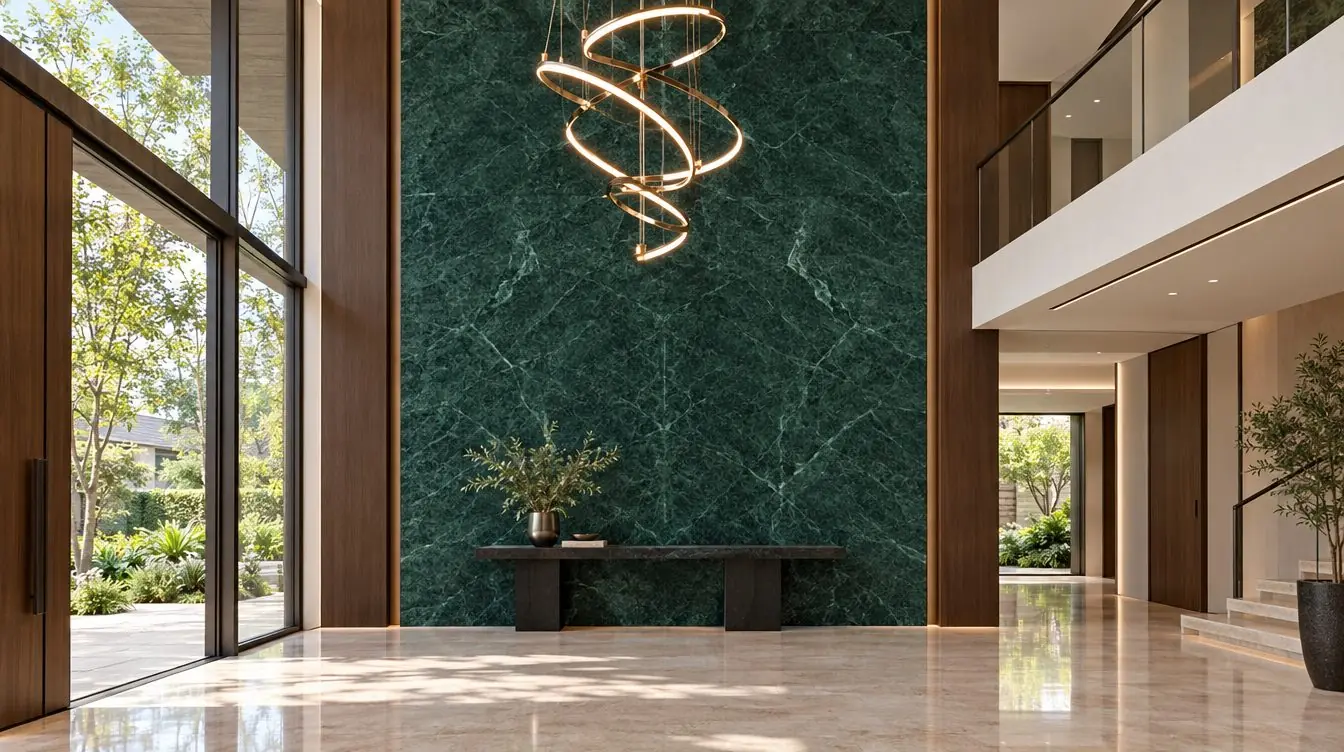
Book-matching means placing two consecutive slabs from the same block side by side, with one opened like the pages of a book, so the veining mirrors along the joint. Laid together, they form a single symmetrical pattern that reads as one piece of stone.
It is one of the most dramatic ways to use a strongly veined marble on a feature wall, a floor centre, a vanity back or a fireplace surround.
How the slabs are made
When a block of marble is sawn into slabs, neighbouring slabs share almost the same pattern. Turn one over and the two faces mirror each other. A four-way match goes further, using four consecutive slabs to build a diamond or butterfly shape.
The quality of the effect depends on slabs being kept in the order they were cut. If they are separated or shuffled, the match is lost. Each slab should be numbered and kept together from the quarry to the site.
A simple pair is the most common and the most affordable way to try the idea, with larger arrangements reserved for focal walls.
Stones that suit it
Stones with bold, directional veining work best, such as Statuario from Carrara, Italy, many onyxes and dramatic greens like Udaipur Green. Very uniform stones gain little from book-matching because there is no pattern to mirror. The Italian marble range has several candidates, and the onyx range is a natural fit for walls where the pattern is the point.
Planning ahead
Book-matching needs slabs cut in sequence from the same block, with the correct faces polished and with enough slabs reserved to cover the full area. This must be planned before the stone is ordered, not after. Decide the wall height and width first, because the number of matched pairs depends on it.
Large areas also use more stone, as the pattern is positioned rather than simply laid out, and edges are trimmed to centre the veining. Ask for a layout drawing before any slab is cut.
Installation
Accurate alignment at the joint is everything. Your fabricator should lay out the slabs dry before fixing them, mark the order, and keep the joint tight and even. Vertical walls need proper fixing systems for the weight of the stone, which your contractor will specify. A thin joint in a matching colour makes the pattern read as continuous.
Common uses and limits
Beyond walls, book-matching is popular for vanity splashbacks, reception desks and the face of a kitchen island. On floors it is used more rarely, because traffic wears the centre where the pattern is strongest. Remember that a mirrored pattern also draws attention to any difference in shade between slabs, so inspect the pair under good light.
If your wall has sockets, niches or windows, tell the contractor early, since cut-outs interrupt the pattern and can be positioned to disturb it as little as possible.
Seeing it before you commit
A photograph of a book-matched pair can be misleading, because lighting and polish change how the veining looks. Seeing the actual sequenced slabs at our experience centre, with the pair next to each other, is the surest way to judge the final effect. For a related idea on lighting stone, read about backlit onyx feature walls, or send an enquiry with your wall dimensions.