How backlit onyx works
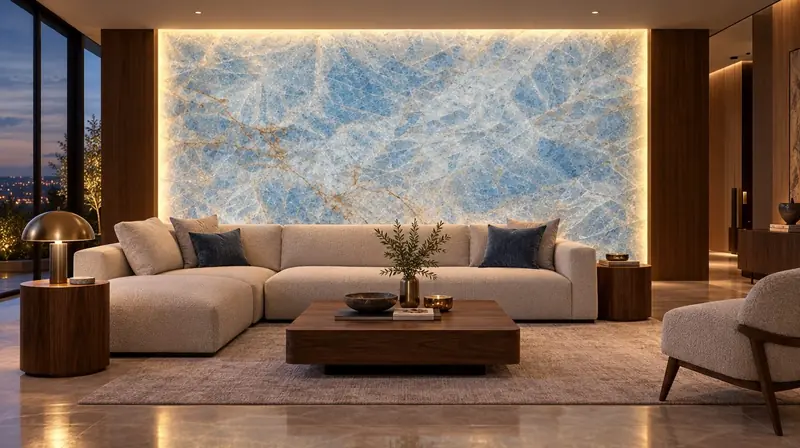
Onyx is translucent: put a light behind a thin slab and the bands and clouds in the stone glow, which turns a bar front, a feature wall or a bathroom panel into the focal point of a room. The glow comes from light passing through the crystalline layers of the stone, so the thinner and more even the slab, the more light gets through.
Onyx is a banded, calcite-based stone, closely related to marble in chemistry but formed differently, in layers. That layering is what gives the flowing stripes. It is also why onyx behaves differently from marble in a home, and why it is chosen for a few carefully planned surfaces rather than a whole house.
Choosing a slab
Look for even translucency and banding you love, because backlighting exaggerates both. A slab with a dense, opaque patch will show as a dark island once lit, and a band you only half liked in daylight will become the loudest thing on the wall.
Honey, green, pink, blue and white onyx each give a very different glow. Compare Champagne Onyx, Green Onyx and Pink Onyx, all listed in our range with Isfahan, Iran as their origin. Warm honey tones feel welcoming in a dining area, while cooler greys and whites suit a modern bathroom. The full onyx collection shows the spread of colour.
Onyx also differs from slab to slab, so reserve the exact pieces for one wall rather than mixing lots. Keep the panel size in mind too: a large wall will need several pieces, and the joints between them are visible when lit. Ask your fabricator to align the banding across the joints.
Thickness and backing
Onyx is brittle. For backlit panels it is usually cut thin, and fabricators commonly bond it to a supporting backing so that it can be handled and fixed to a wall without cracking. Ask your fabricator how the panel will be backed, because the backing should not block the light or yellow over time.
Because onyx is softer than most marbles, it is better on walls, bar fronts and decorative panels than on floors or busy counter tops. It scratches more easily and reacts to acids, so a lemon-cutting bar top in onyx needs thought.
Planning the lighting
The light matters as much as the stone. LED strips or panels are the usual choice because they run cool, and heat is not kind to a thin stone panel or its adhesive. Leave enough depth behind the slab so the light source is not visible as bright dots. Even spacing and a diffuser help the glow look smooth.
Plan access too. LEDs eventually need replacing, so a removable panel or service route behind the wall saves the stone from being disturbed later. The electrician and your stone contractor should agree on this before the wall is built, not after.
Cleaning and care
Wipe onyx with a soft damp cloth and a stone-safe cleaner. Avoid acidic products, abrasive pads and anything strong. A sealer suited to the stone is sensible, especially on a bar or in a bathroom where splashes are likely.
Onyx rewards looking at it in person. Photographs flatten the translucency, and a slab held up to a light tells you far more than a catalogue image. You can see slabs at our experience centre in Rajouri Garden, and our note on backlit onyx feature walls goes further into layout.