Is quartzite better than marble?
For a kitchen or any surface that takes daily use, yes: natural quartzite is much harder than marble and far less sensitive to acids, while offering a similar flowing pattern. Marble still wins on availability of classic white and gold looks and on warmth.
The catch is that the word quartzite is used loosely in the trade, so it pays to understand what you are buying.
| Quartzite | Marble | |
|---|---|---|
| Formed from | Sandstone | Limestone |
| Hardness | Very hard | Softer |
| Acids | True quartzite generally resists | Etch a polished surface |
| Look | Often marble-like with crystalline depth | Soft, flowing veins |
| Check before buying | Ask for a scratch and acid test, as some stones sold as quartzite are softer | Grade, repairs and veining across the slab |
What quartzite is
Natural quartzite is a metamorphic rock formed when sandstone is subjected to great heat and pressure, fusing its quartz grains together. The result is a very hard stone, often with flowing patterns that resemble marble. Marble comes from limestone, so the two start from different material and end up with very different behaviour. That difference is why quartzite behaves like a tougher stone, and why it can handle heat, knocks and daily cleaning better than marble does.
Not the same as quartz
Quartzite is natural stone. Quartz surfaces, sometimes called engineered quartz, are manufactured from crushed quartz bound with resin. The names are easily confused, but the materials are entirely different: one is quarried, the other made in a factory. Heat tolerance, appearance and how they age are not the same.
Hardness and everyday use
Quartzite is typically as hard as granite or harder, and much harder than marble. It resists scratching and is far less affected by acids, which makes it a good choice for kitchens where you want a marble look without marble's sensitivity. It is still a natural stone, so sealing is sensible, and very dense varieties can be a little slower to absorb sealer. Compare it with our granite for kitchen options if the countertop is the main use.
Sealing is usually done after installation and repeated now and then. Ask your supplier or contractor what sealer suits the specific stone you choose.
Varieties to look at
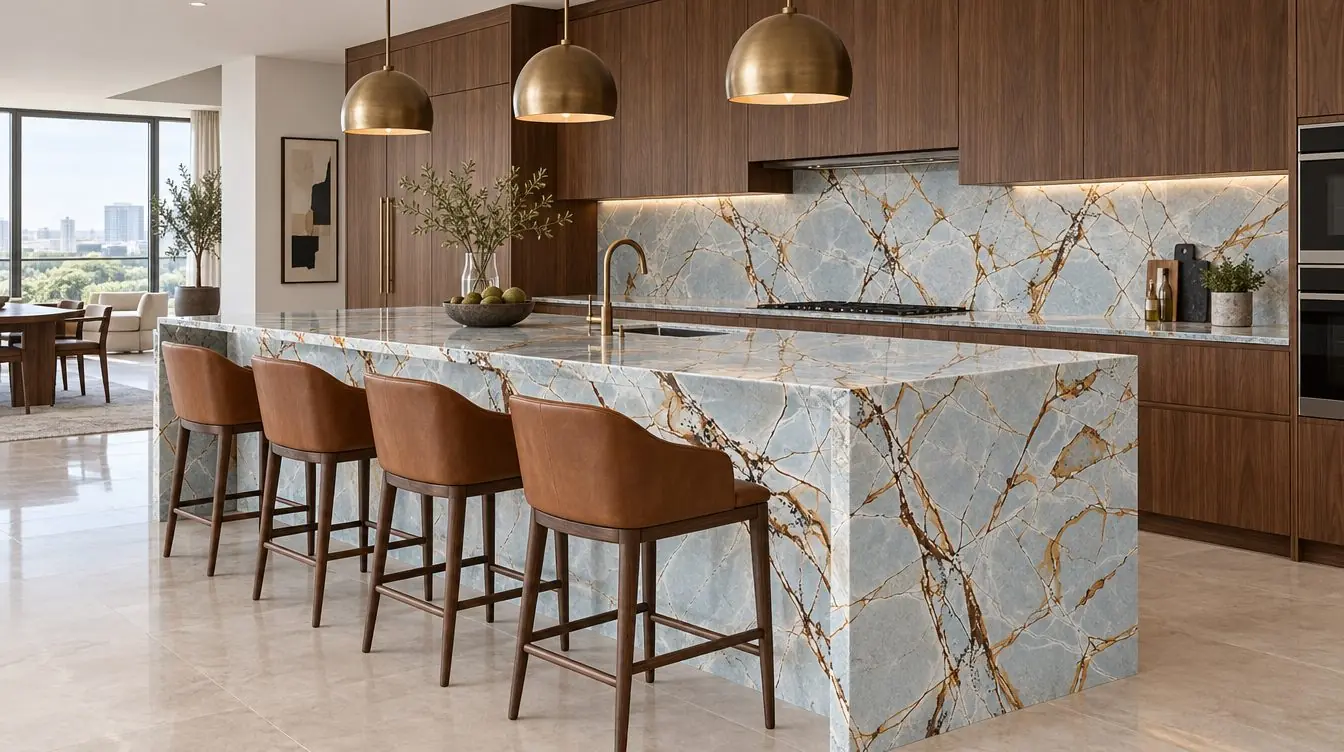
Quartzites range from translucent whites like Cristallo to dramatic blues like Roma Blue and earthy tones like Cafe Moca, all part of our marble collection page. Brazil is a well-known source of quartzite worldwide, though colours and names vary by supplier, and the same stone may be sold under several names.
Quartzite and marble side by side
Marble gives a softer, creamier feel and the classic white and gold veining people picture when they say luxury. Quartzite looks crisper and often more crystalline, and its patterns can be more abstract. Neither is simply better, and many buyers use marble on walls and floors and quartzite where the work happens.
It is also worth remembering that supply is thinner than for common marbles, so a particular quartzite may need more lead time. Ask about availability and slab matching early, especially for a large kitchen.
What to check before buying
Some stones sold as quartzite are actually softer, marble-like stones, or a mix of the two. Ask for a scratch test and an acid test on a sample: a true quartzite should not etch when a drop of lemon juice is left on it. Make sure the sample is from the same lot as your slabs.
Hardness also makes quartzite slower and more demanding to cut and finish, which usually affects the fabrication cost. Your fabricator should confirm whether they work with it. If you are unsure whether you want the look of marble or the toughness of quartzite, read about marble versus granite too. Slabs can be viewed at the experience centre.